Boxed In, Not Boxed Out: Storage Crates That Survive the Van and the Site
Trade customers rarely get excited about a storage box. They get annoyed by one. A crate that splits at the corner, a lid that pops off halfway across a car park, or an organiser box whose dividers collapse the first time it is tipped up — those are the details that decide whether a line sells once or sells again. At J&S Products, storage is one of those quiet categories where the counter can do a lot of the selling, provided the stock is chosen for real site use rather than shelf appeal.
Start with the load, not the look
A storage crate can look tough and still be built for lightweight household clutter. Trade buyers are usually carrying screws, fittings, fixings, hand tools, sealant tubes or van odds and ends — often all in the same week. Ask what the box is actually expected to hold, then check whether the supplier gives a load rating in kilograms rather than vague phrases like “heavy duty”.
Load ratings matter most when crates are stacked. The bottom box carries the weight of everything above it, so a crate that is fine on its own may bow or crack in a tower. Look at the base, the corner mouldings and the handle area. If a supplier cannot state a sensible load, treat the product as a counter-top tidy rather than a site box. That is not a criticism of the product; it is a question of honest positioning.
Dimensions that match the van, the shelf and the site
External dimensions sell boxes. Internal dimensions solve problems. A crate that fits neatly under a bench but cannot take a standard fitting tray is less useful than it looks. Check internal length, width and depth, and remember that handles, lid rims and stacking feet all add bulk on the outside.
Modular sizing is worth more than a long catalogue of one-offs. A small range of crates that stack together, sit side by side in van racking and slide onto a trade counter shelf will usually outperform a wall of near-identical boxes. If a customer has to measure three times and still guess, the line is making work for them. Show the footprint clearly on the shelf edge or with a simple display card, and let the boxes do the rest.
Lids, latches and the one-handed test
A lid is either a useful part of the box or a loose piece of plastic waiting to go missing. Hinged lids suit organiser boxes and small-parts crates. Separate lids can be fine for larger storage, but only if they clip down securely and can be removed without a fight.
Do the one-handed test before you range a line. Pick the box up by the handle, with the lid closed and a bit of weight inside. Does the lid stay put? Can you open the latch with a work glove on? If the answer is no, expect returns. The same goes for organiser boxes: check that the hinges feel substantial and that the compartments stay in place when the box is carried upright. A box that spills its contents is not storage; it is a small disaster with a handle.
Stack stability: the tower test
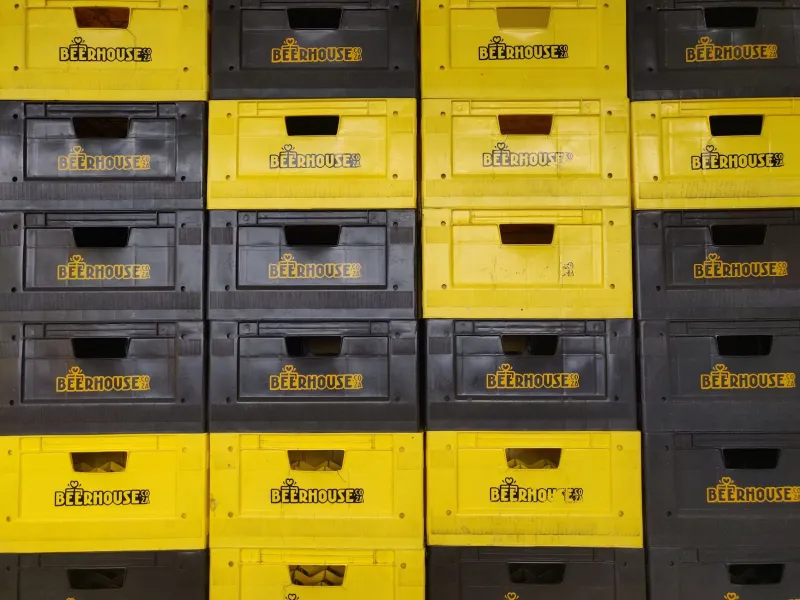
Stacking is where sensible storage lines earn their keep. Empty boxes can feel stable and still behave badly once loaded. Build a small tower on the counter — three high is enough — and give it a gentle nudge. Does it sit square? Do the feet locate into the lid recess? Does the stack lean because one box is slightly different from the next?
Interlocking feet and moulded lid recesses are worth looking for. So is a consistent height across the range. A wobbly display stack is a warning sign, not a merchandising opportunity. Trade customers notice it, even if they do not say so.
Labelling that survives the site
Most trade storage is not labelled by product code. It is labelled by job, room, van shelf or customer. That means blank space matters. Moulded label areas, wipe-clean panels and card holders are more useful than a glossy finish. Paper stickers peel in a cold van and smudge on site, so a simple clear pocket or a textured panel that takes a marker pen can be the difference between a box that gets used and one that gets abandoned.
If you are ranging organiser boxes, check whether the dividers can be moved or added to. A box with fixed compartments may suit one trade and frustrate the next. Adjustable dividers are not a luxury; they are what makes a small-parts box flexible enough to sell across several trades.
The counter test that sorts the line
You do not need a lab to judge a storage crate. Put one sample on the counter, out of its packaging, with a few real fittings or a couple of hand tools inside. Let customers lift it, open it, stack it and carry it by the handle. Watch how they pick it up. If they reach for the lid rather than the handle, the handle is in the wrong place or the box is too heavy for its own good.
Ask one straightforward question: “Would you take that back to the van?” The answer tells you more than a supplier brochure. Keep a note of any returns or complaints — cracked bases, failed latches, missing lids — and use that to trim the range. A storage line that comes back for a second purchase is doing its job. A storage line that comes back as a complaint is taking up shelf space that could go to something better.
Range less, choose better
Storage is one of those categories where a tighter range often sells better. Three or four core crate sizes that stack together, plus a sensible organiser box and a couple of lid or divider options, will cover most trade counters without turning the aisle into a guessing game. Clear boxes suit small parts and retail pick-and-pack. Solid colours suit site use and van storage. Either way, the customer should be able to see at a glance which box fits which job.
At J&S Products, the practical test is simple: stock storage that trade customers keep using, not just the boxes that look good on the shelf. Get the load rating, internal size, lid security and stack stability right, and the range will earn its place — one repeat sale at a time.